
Furniture Expenditure per Capita: Country-Level Trends in Major Retail Markets
Furniture demand is closely linked to household consumption patterns, housing conditions, and broader economic cycles, yet cross-country evidence on how this demand evolves over time remains limited. This article explores furniture expenditure per capita, using retail turnover data to provide a consumer-facing perspective on demand dynamics across major markets. The indicator is used to examine both within-country trends over time and broad cross-country differences, while acknowledging remaining limitations in level comparability.
Indicator and interpretation
Analyses of furniture markets typically rely on production data, trade statistics, or housing-related indicators, which provide important but indirect information on final demand. To shed light on the consumer-facing side of the market, furniture expenditure per capita—measured as furniture retail turnover divided by total population—offers a complementary perspective. While this measure is based on retail sales rather than national accounts consumption, it provides a timely and broadly harmonised indicator of demand intensity that is particularly useful for tracking country-level trends and cyclical movements.
Furniture retail demand dynamics
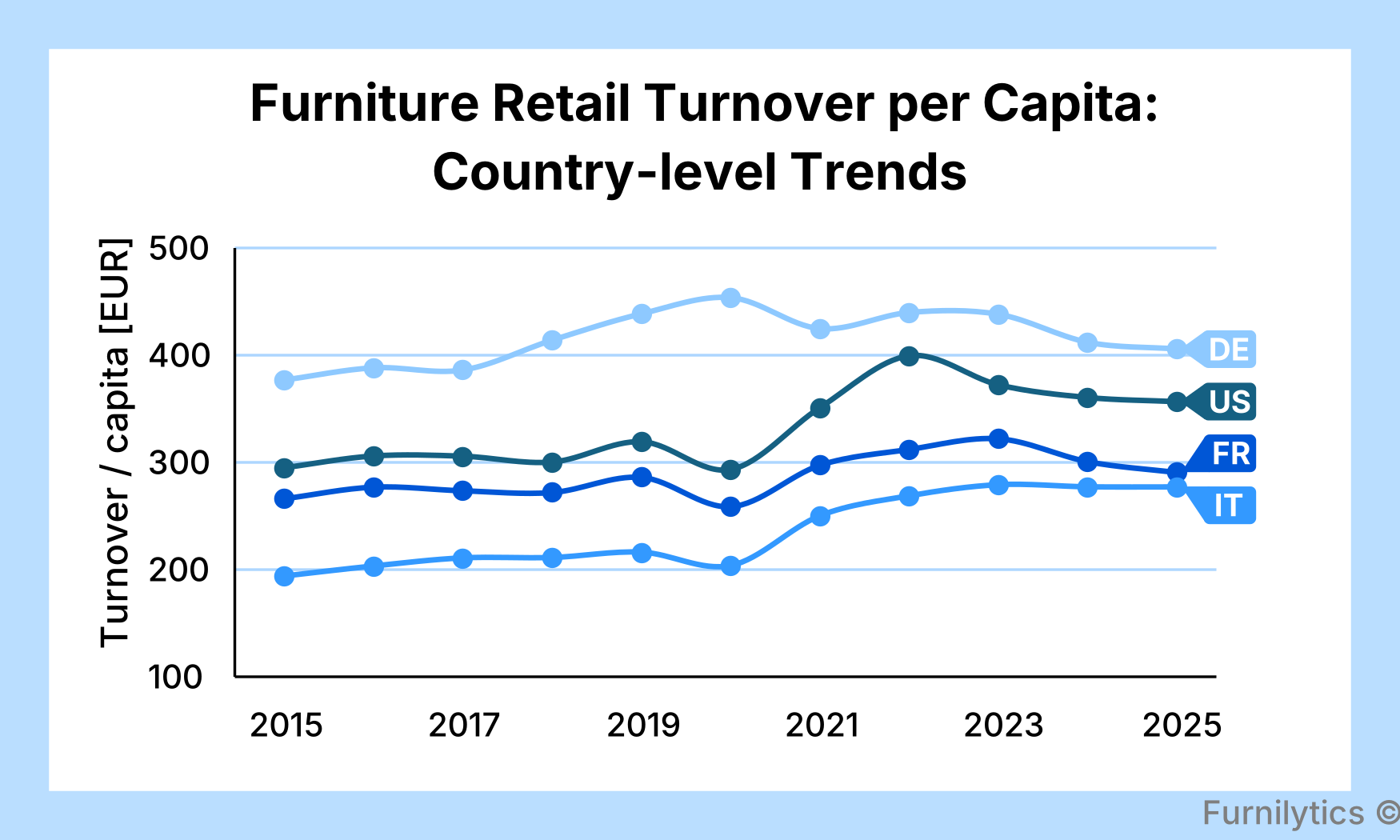
Across countries, furniture retail turnover per capita shows a common cycle, with a clear dip in 2020 followed by a strong rebound in 2021–2022. This pattern reflects pandemic-related disruptions, pent-up demand, and shifts in household spending toward home-related goods. The rebound is most pronounced in the United States, where per-capita turnover peaks sharply in 2022 before easing thereafter.
European markets exhibit a more gradual and heterogeneous adjustment. From 2023 onward, all markets show signs of stabilisation or cooling, highlighting both the synchronised nature of recent demand shocks and persistent cross-country differences in furniture retail dynamics.
Cross-country level differences
While the indicator is primarily intended to compare trends, it also points to a relatively stable ordering of per-capita furniture retail turnover across countries. Germany and the United States consistently show higher per-capita values than France and Italy over most of the period.
More recently, however, Italy does not exhibit the same post-2022 decline observed in other markets, resulting in per-capita levels that are broadly comparable to those in France. These differences should be interpreted with caution, as they are influenced by price developments, tax treatment, and structural characteristics of national retail markets.
Price effects and interpretation of nominal trends
It is important to note that the series are expressed in current prices, meaning that changes in furniture prices also affect the levels shown. The sharp rise in per-capita turnover in 2021–2022 partly reflects furniture price inflation linked to supply disruptions and higher input and logistics costs, implying that nominal growth may overstate volume increases. The subsequent stabilisation or decline may therefore reflect easing price pressures alongside weaker real demand. As a result, the indicator should be interpreted primarily as a measure of nominal spending intensity, with cross-country differences also influenced by heterogeneous inflation dynamics and tax treatment.
Conclusion
The analysis highlights a broadly synchronised cycle in furniture retail demand across countries, with a sharp contraction in 2020, a strong rebound in 2021–2022, and a subsequent phase of stabilisation or cooling. While the pandemic shock and recovery were common, adjustment paths differed, with the United States showing the most pronounced surge and European markets exhibiting more gradual and heterogeneous dynamics.
At the same time, the indicator points to persistent differences in spending intensity, with Germany and the United States generally above France and Italy, and Italy converging toward France in more recent years. These patterns underscore the value of the indicator for comparing country-level trends and relative positioning over time, while level differences should be interpreted cautiously given remaining methodological and price-related differences across markets.
Sources:
Eurostat - structural business statistics
Eurostat - Population (national level)
German Federal Statistical Office - Destatis
French National Institute of Statistics and Economic Studies - INSEE
Italian National Institute of Statistics - ISTAT
Federal Reserve Economic Data (FRED) - Retail Sales: Furniture and Home Furnishings
Federal Reserve Economic Data (FRED) - Population, total for United States
Methodology & limitations:
Monthly furniture retail series were taken from national sources for Germany, France, Italy, and the United States. For European countries, missing annual turnover levels were filled using temporal disaggregation, benchmarking monthly indices to Eurostat Structural Business Statistics (SBS), which report annual net turnover (ex-VAT) for enterprises mainly in furniture retail (NACE 47.59). The US series (FRED MRTSSM442USN) is available as a monthly level. USD values were converted to EUR using average annual ECB exchange rates. All turnover series were divided by annual population to estimate average per-capita furniture retail spending.
The resulting per-capita furniture retail series are intended as a harmonised indicator for comparing country-level trends and dynamics over time, rather than precise cross-country differences in consumption levels, given remaining differences in coverage, concepts, and measurement across national data sources. Comparability is affected by differences in coverage and concepts: SBS measures enterprise turnover in NACE 47.59, ISTAT monthly data cover furniture sales across all retail channels, and US data reflect gross retail sales and are not benchmarked to SBS-style statistics. Temporal disaggregation assumes that monthly index movements correctly reflect the intra-year distribution of annual turnover, and per-capita figures do not account for household structure, tourism, or cross-border consumption.