
AI Recommendations in Furniture Retail: A GEO Case Study of France
AI shopping recommendations are becoming increasingly important as consumers use AI assistants to research products and discover retailers. For furniture businesses, this makes generative engine optimisation (GEO), or visibility in AI-generated answers, a growing consideration alongside traditional search visibility.
This analysis examines AI recommendations for furniture retailers in France, comparing purchase intents, product categories and cities. The case study highlights how recommendation patterns vary and why measuring GEO visibility requires more than a single retailer ranking.
Testing AI Recommendations in Furniture Retail
AI recommendations are becoming relevant to retail discovery. A 2026 IBM and National Retail Federation study reported that 41% of surveyed consumers globally use AI assistants to research products.
This analysis uses France as a case study, testing retailer recommendations across four cities and six furniture categories. Purchase questions and versions specifying “good quality” were each repeated three times using OpenAI’s API with web search, without user personalization. Ranking-based scores capture retailer inclusion and prominence, allowing comparisons by question type, category and city.
Purchase Intent Changes Retailer Prominence
Quality-oriented purchase intent changed which retailers received prominence. Across the same French cities and product categories, the selected design-focused retailers scored higher for quality-oriented questions, while the selected general furniture retailers scored higher for general purchase questions.
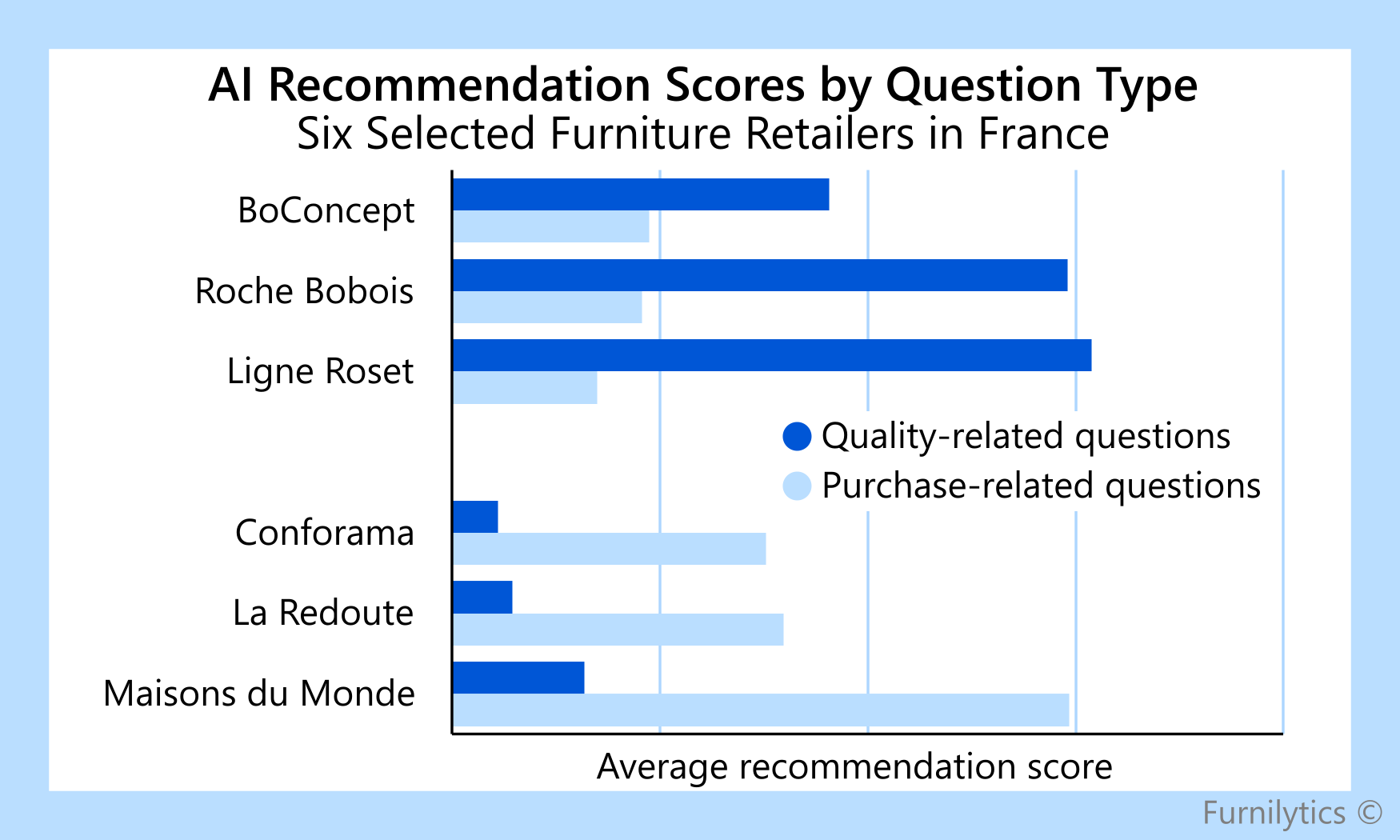
Ligne Roset’s average score increased from 1.40 for general purchase questions to 6.15 for quality-oriented questions, while Roche Bobois rose from 1.83 to 5.92. Maisons du Monde showed the reverse pattern, scoring 5.94 and 1.27, respectively. Scores combine inclusion and ranking position: being mentioned does not necessarily mean receiving a prominent recommendation.
The wider sample showed that quality-oriented purchase intent mainly reshuffled established retailer networks, rather than favouring local businesses. The graph illustrates how the model responded to an added shopping requirement; it does not independently establish differences in product quality.
International Retailers Lead in Visibility
International retailers accounted for the largest share of recommendation points in five of the six categories, particularly fitted kitchens, sofas and wardrobes. Local/regional businesses generally received a much smaller share, including in broad furniture recommendations.

Mattresses were the clearest exception. Local/regional retailers received approximately 26% of recommendation points, compared with around 4% for general furniture questions. National/France-focused and online-led retailers also had greater representation in mattresses, producing a more balanced retailer mix.
The overall pattern shows strong visibility for international retail networks, with more limited prominence for local businesses. Product-specific questions created greater local visibility in some categories, but this was not consistent across furniture retail. Broad furniture questions alone would therefore miss meaningful differences between categories.
Recommendations Vary by City
Retailer prominence also differed between cities, even when the product categories and purchase intents were held consistent. The selected retailers show distinct recommendation profiles across Paris, Lyon, Marseille and Bordeaux.
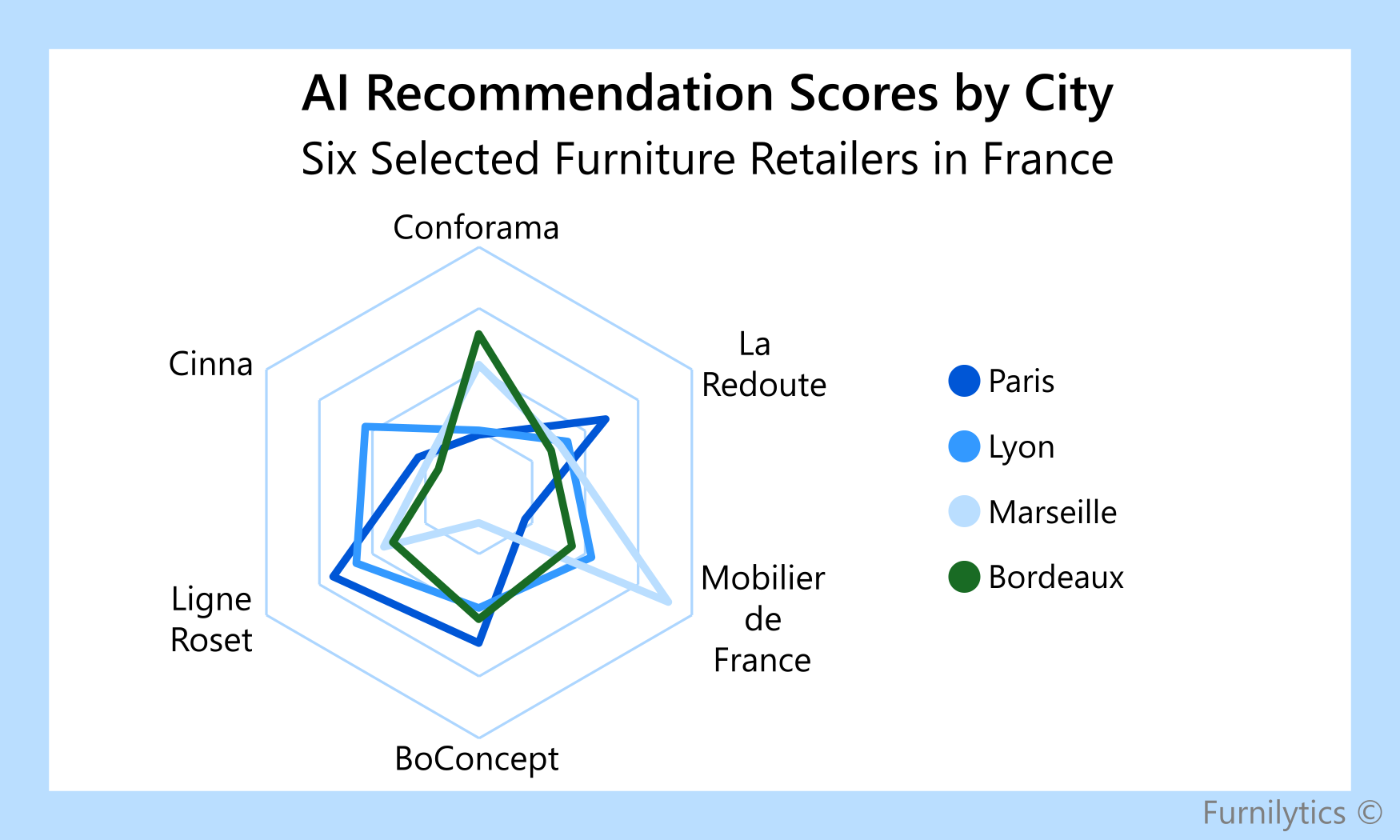
Mobilier de France scored 6.13 in Marseille compared with 0.73 in Paris, while Conforama scored 4.17 in Bordeaux versus 0.87 in Paris. Ligne Roset showed the opposite geographic pattern, receiving a higher score in Paris than in Bordeaux or Marseille.
Physical presence alone does not explain these differences. BoConcept received no recommendations in the Marseille sample despite having a store in nearby Aubagne. This illustrates how a retailer can have a local presence without appearing in the tested shortlists. The city differences are descriptive, and the experiment does not establish what caused them.
Furnilytics offers GEO reviews for furniture retailers, assessing visibility in AI recommendations across purchase intents, product categories and locations.
Contact us to discuss a review.
Conclusion
The French case study shows that AI recommendation visibility varies with purchase intent, product category and city. Quality-oriented questions shifted prominence towards design-focused retailers, while international networks led across most categories. Local/regional businesses generally received less visibility, with mattresses providing the clearest exception.
Retailer inclusion and ranking position also tell different stories. Appearing in an answer does not guarantee a prominent recommendation, just as having a nearby store does not guarantee inclusion. A single national score or broad furniture question would conceal these differences.
For furniture retailers assessing GEO, a useful starting point is repeated measurement across relevant shopping questions, categories and locations. This establishes where visibility is strong or limited. The experiment does not identify what caused the recommendations or demonstrate which optimisation measures would improve them.
Sources:
OpenAI Responses API - search-enabled GPT-6 Luna collected on 21-10-2026
Methodology & limitations:
French-language questions requested a ranked top ten of retailers across Paris, Lyon, Marseille and Bordeaux for general furniture, sofas, mattresses, dining tables, wardrobes and fitted kitchens. Purchase questions were compared with questions specifying “good quality”, with three independent repetitions per combination. API calls used web search and approximate city location, without user profiles, conversation history or supplied retailer lists; responses therefore did not incorporate individual user personalization. Of 244 planned answers, 242 were usable.
Retailer names were standardised, counting each retailer once per answer. First position received ten points, declining to one for tenth; absence scored zero. Average scores include all eligible answers. Retailer-type shares use classified ranking points, distinguishing international, national/France-focused, online-led and local/regional businesses.
Results reflect one model, collection date and set of questions, and may differ from personalized consumer ChatGPT responses. Three repetitions provide limited evidence of stability; differences are descriptive rather than statistically established. Selected-retailer charts do not represent the complete ranking. Physical presence does not guarantee product availability, and online retailers may remain relevant without nearby stores. Scores measure visibility in requested shortlists, not actual consumer exposure, market share or independently verified product quality.