
France Furniture Outlook: Housing Market Signals
The French furniture market remains under pressure following the post-pandemic correction, with retail turnover declining from its 2023 peak. At the same time, residential building permits and housing transactions remain below their 2019 levels, raising questions about when furniture demand could recover.
This analysis reviews recent French furniture retail turnover, housing-market activity and the statistical relationship between residential permits and subsequent retail performance. It examines whether housing indicators provide an early signal for furniture demand and what current permit trends may indicate for the French furniture market outlook through 2027.
French furniture retail remains under pressure
French furniture retail has moved from a strong post-pandemic recovery into a prolonged downturn. The 12-month trailing average peaked at approximately 1.86 billion euro per month in August 2023, before declining almost 11% to 1.66 billion euro by July 2026. The latest monthly result remained weak, with turnover in July 2.7% lower than one year earlier.
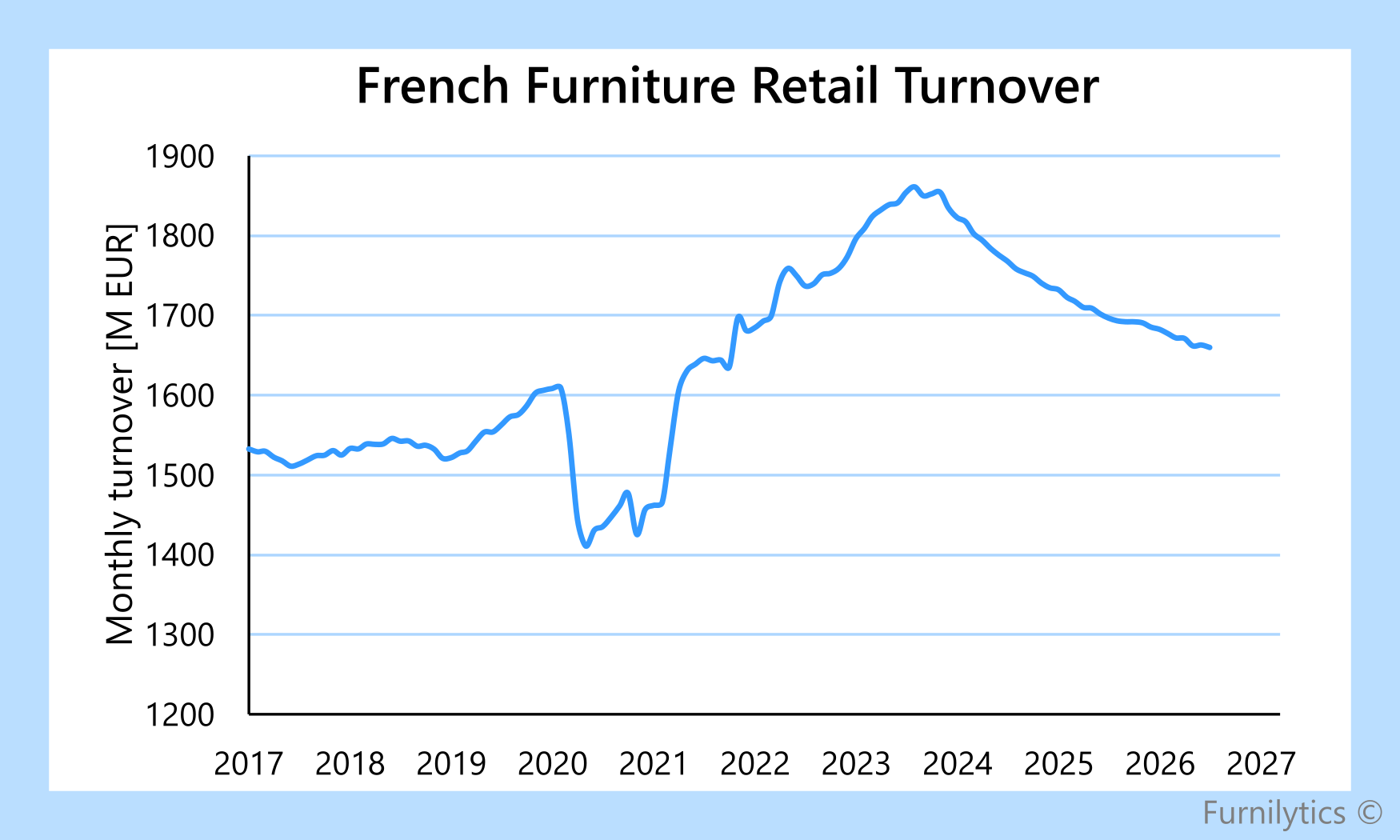
The decline has continued for almost three years and therefore appears broader than short-term monthly volatility. Turnover remains above the pre-pandemic range of approximately 1.51–1.55 billion euro per month in nominal terms, although this comparison does not account for furniture-price inflation. Assessing whether the market is approaching a turning point requires looking at the underlying factors that generate demand—and housing activity is particularly relevant.
Moving into a new home is often a major trigger for furniture expenditure. Buyers may need furniture suited to different room dimensions, furnish additional rooms or replace items that do not fit the new property. Research from Canada and the United States similarly indicates that furniture purchases often increase around a move. Housing transactions can therefore provide a relatively direct demand signal, while residential permits sit earlier in the process and may indicate future furnishing demand once homes are built and occupied. Together, these indicators can help assess whether the French retail downturn is likely to ease or persist
French housing activity remains subdued
French housing activity followed a similar post-pandemic cycle. The six-month average of transactions peaked at approximately 125 index points in 2021, while residential permits reached a comparable peak in 2022. Both then declined sharply, falling to around 65-70 points during 2024.
A partial recovery followed but did not develop into a sustained rebound. By September 2026, the six-month averages stood at approximately 81 for transactions and 70 for permits, compared with the 2019 baseline of 100. Both indicators have recently weakened again.
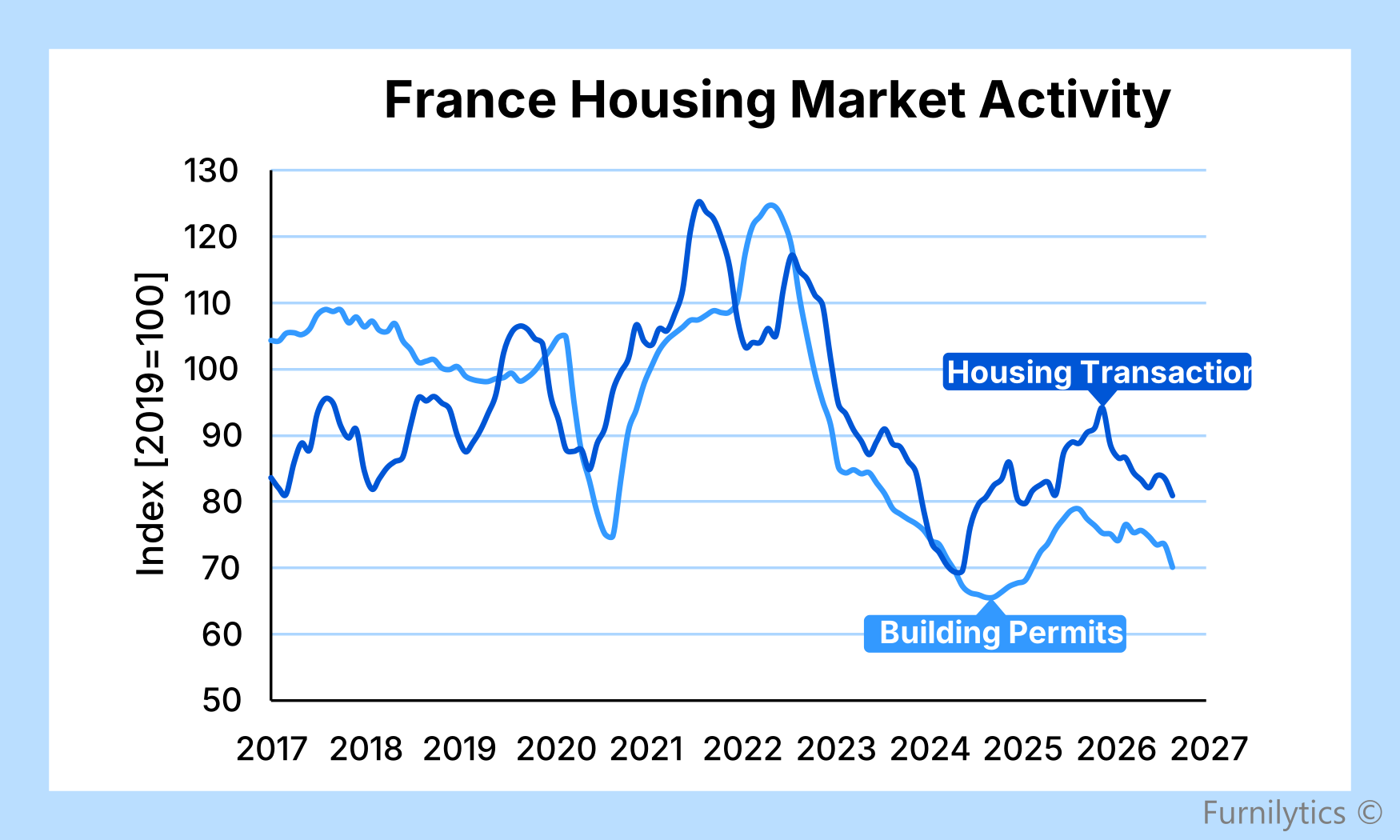
Transactions reflect homes changing hands and should therefore be relatively close to furniture purchases associated with moving. Permits sit much earlier in the housing cycle. If they contain a useful retail signal, it should appear several months before the related furniture demand.
Current housing activity provides little evidence of an immediate demand recovery. The different timing of permits and transactions, however, makes it important to test whether either indicator provides an earlier signal for furniture retail.
Permits provide the clearest forward signal
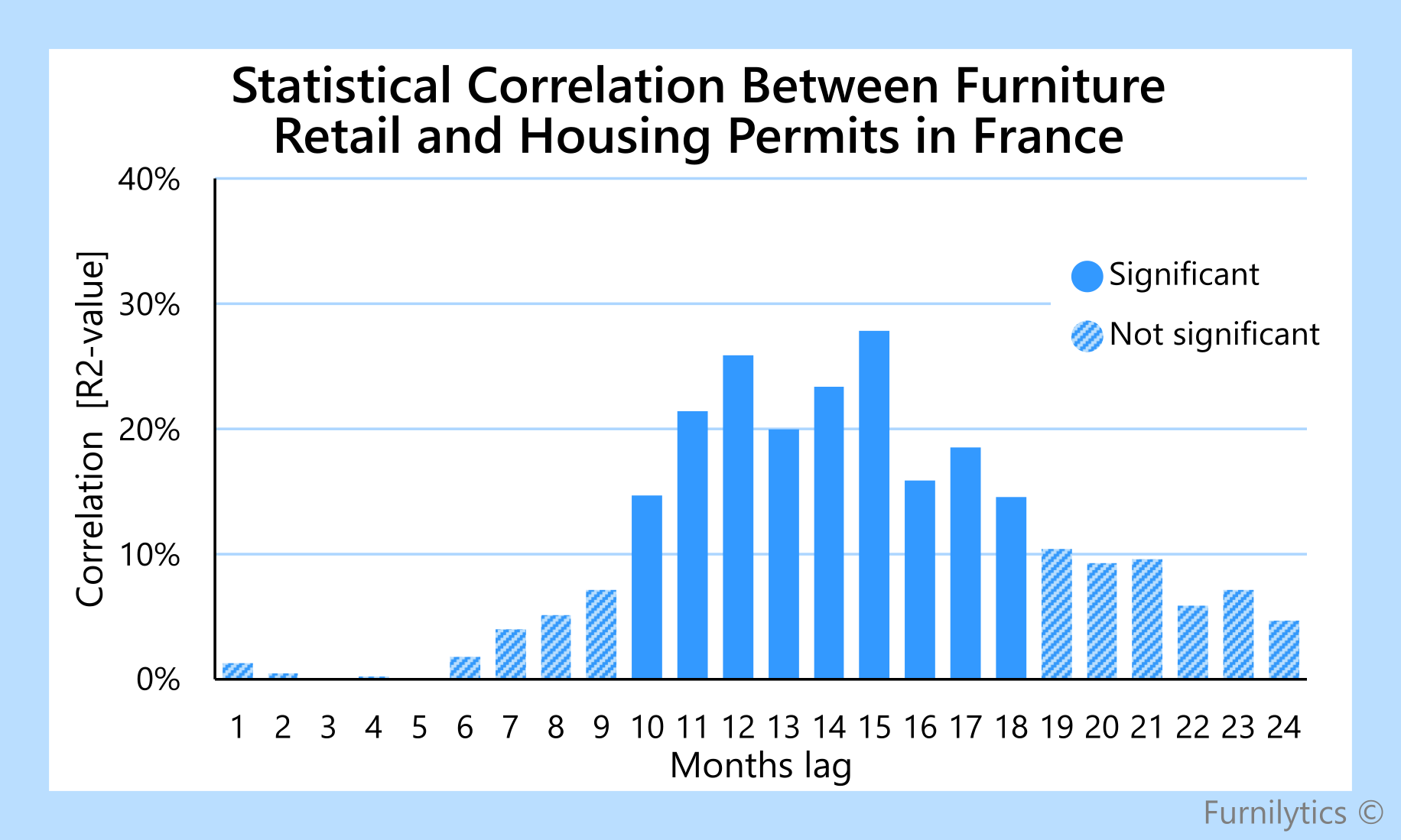
To test whether housing activity precedes furniture demand, we compared year-on-year furniture retail growth with permit growth at leads ranging from zero to 24 months. The conservative analysis excludes observation pairs when either the retail month or corresponding permit month falls within the disruptive period from March 2020 to December 2021.
The relationship is weak at short leads but becomes stronger after approximately nine months. It is most pronounced between 12 and 15 months: permits explain approximately 26% of the variation in retail growth at a 12-month lead and 28% at 15 months. Both results are statistically significant. Looking only at the cycle since 2022 produces an even stronger 12-month relationship, but the longer conservative test provides the safer basis for interpretation.
Housing transactions did not show the same robust direct relationship once the COVID period was removed. This suggests that transactions describe current housing-market conditions but add limited statistical information about subsequent furniture retail movement. Permits appear more useful because they capture an earlier stage of the housing pipeline.
The latest permit data provide a mixed signal for the near future. Permit growth was positive through March 2026, which could offer some support to furniture retail into early 2027 if the recent relationship persists. From April through September 2026, however, permits were again lower than one year earlier. With a lead of approximately 12–15 months, this points to renewed downside risk for furniture demand from spring into late 2027.
The relationship should be treated as directional rather than as a precise forecast. It was not consistently positive before the pandemic, and the timing varies across specifications. Nevertheless, among the housing and consumer indicators tested, residential permits provide the clearest indication of where French furniture demand may be heading approximately one year ahead.
Conclusion
French furniture retail has declined steadily from its 2023 peak, while housing transactions and permits remain well below their 2019 levels. The statistical analysis identifies permits as the clearest forward indicator, with the strongest relationship appearing 12-15 months before furniture retail movement.
Positive permit growth through March 2026 may support demand into early 2027. However, the renewed decline from April onward points to weaker conditions from spring into late 2027 if the recent relationship persists.
Overall, the indicators suggest that a broad housing-led recovery is not yet visible. Permits provide a useful early signal, but they should be interpreted alongside retail performance, consumer demand and wider economic conditions rather than as a precise forecast.
Sources:
Furnilytics France furniture retail turnover
Furnilytics France residential construction monthly
Furnilytics France housing transactions monthly
Eurostat building permits monthly
Eurostat house sales statistics
ECB new housing loans for France
Eurostat short-term business statistics methodology
Statistics Canada: On the move with homebuyers
NAHB: What Do Home Buyers Purchase After They Move In
Methodology & limitations:
The analysis uses Furnilytics monthly French furniture retail turnover, residential building permits and housing-transactions data. Furniture retail turnover measures specialist furniture retail turnover. The permit indicator is a seasonally adjusted index of useful residential floor area covered by permits granted, rebased to 2019. The housing-transactions indicator is derived from quarterly Eurostat existing-home transactions and temporally disaggregated using ECB monthly new mortgage lending, then rebased to 2019. It should therefore be interpreted as an estimated monthly indicator rather than an independently observed monthly transaction count. The housing graph shows six-month simple moving averages. The retail graph shows a 12-month trailing simple moving average.
The statistical section compares year-on-year furniture retail growth with earlier year-on-year permit growth over leads of zero to 24 months. The conservative sample removes an observation pair when either its retail month or corresponding permit month falls between March 2020 and December 2021. R² is calculated by squaring the Pearson correlation and therefore does not retain its sign. Solid bars indicate approximate p < 0.01; patterned bars indicate p ≥ 0.01. Results show association and timing, not causation or forecast accuracy. P-values are not adjusted for autocorrelation, multiple lead testing, structural breaks or omitted economic drivers. External Canadian and US research supports only the behavioural connection between moving and furniture expenditure, not a direct estimate for France.