
How AI Shapes Sofa Retailer Visibility in the UK
Consumers are increasingly using AI to decide where to shop, shaping which furniture retailers enter the shortlist before a store or website is visited. Furnilytics tested AI sofa retailer recommendations across three models, three major UK cities and four buying intentions. The results show how retailer visibility changes depending on the model, location and wording of the request.
This analysis is made for Big Furniture Group.
Measuring AI Recommendation Visibility
Furnilytics tested sofa recommendations from OpenAI, Anthropic and Perplexity across London, Birmingham and Manchester. Four requests were used: general, quality-focused, price-focused and style-focused. Each combination was repeated five times, producing 180 responses.
Retailers received ten points for first place down to one point for tenth. Absence received zero. The resulting scores measure recommendation visibility, not market share, sales or verified quality. The model itself strongly influenced the result. OpenAI ranked Sofology highest, while Anthropic and Perplexity favoured DFS. Matched shortlists overlapped by only 18.3% on average, while repeated answers within the same model overlapped by 66.4%. An AI recommendation is therefore a variable snapshot rather than a fixed ranking.
Location changes the retailer shortlist
Location produced clear differences among the five selected retailers. Sofology’s recommendation score rose from 2.25 in London to 5.10 in Birmingham and 6.53 in Manchester. DFS was more consistent across the three cities, while John Lewis performed strongly in London but had very limited visibility in Birmingham.
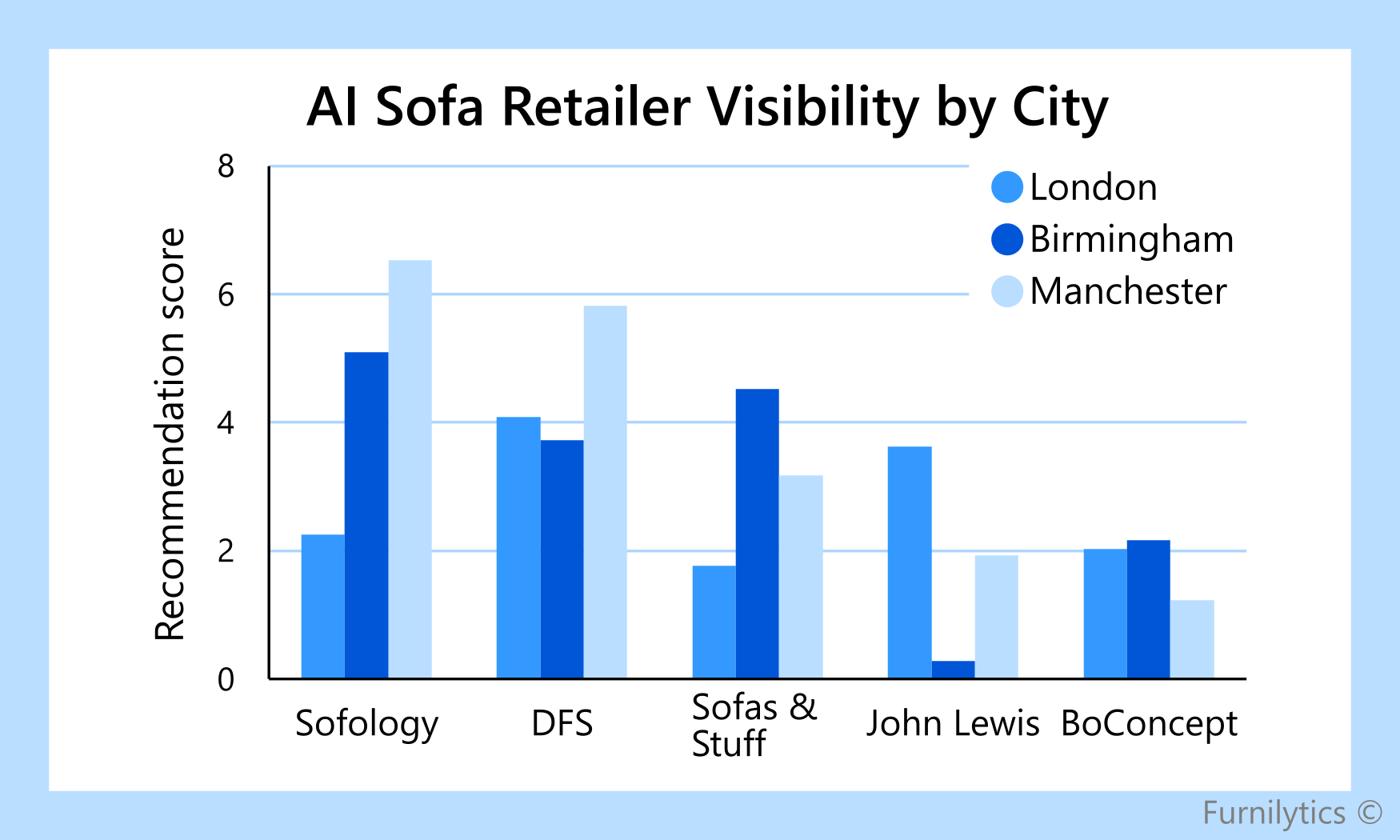
Some of these differences align with physical store presence. John Lewis has stores in London and Greater Manchester, while its Birmingham branch has closed. Store coverage alone does not explain the pattern, however. Sofology, Sofas & Stuff and BoConcept all operate in the three markets but still receive noticeably different scores by city. AI therefore appears to respond to more than store availability. Local online content, competition, brand associations and differences between models may also influence which retailers are recommended.
Buying intent reshapes the shortlist
The way a shopper phrases the request changes which retailers receive the most visibility. DFS led the general request with a score of 7.44, while Sofas & Stuff ranked highest for quality at 5.18. BoConcept showed the clearest specialisation, rising to 4.80 for style but receiving almost no visibility for price.
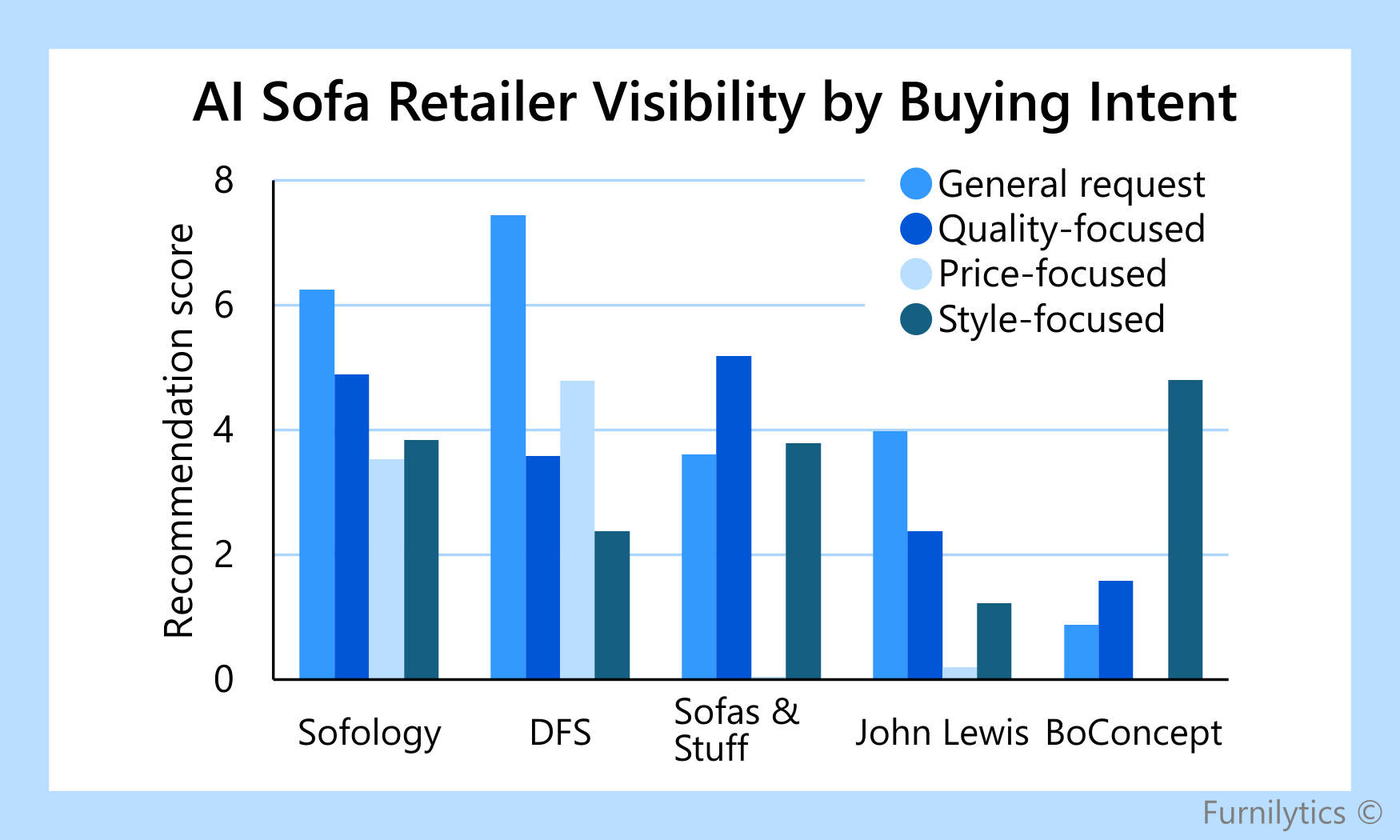
Sofology had the most balanced presence across all four intentions. It did not lead every category, but remained visible for general, quality, price and style requests. John Lewis was associated mainly with general and quality-focused searches, while DFS also remained prominent for price. The results show that AI associates retailers with different consumer needs. Visibility depends not only on overall brand prominence, but also on how strongly a retailer is connected with quality, affordability or style.
Conclusion
The study shows that AI recommendations are shaped by three factors: the model being used, the shopper’s location and the intention behind the request. A retailer that performs strongly in one city or for one type of shopper may be far less visible in another context.
For furniture retailers, this creates a new measurement challenge. AI visibility should be monitored across several models, locations and buying intentions rather than through a single prompt. Clear local information and consistent signals around quality, price and style may help retailers appear in the situations most relevant to their target customers. As AI becomes part of product discovery, understanding these differences will become increasingly important.
Sources:
OpenAI GPT-4.1 mini model documentation
Anthropic Claude model documentation
Perplexity Fast Search documentation
Sofology store locator
Sofas & Stuff showroom directory
BoConcept UK store directory
John Lewis shop information
Methodology & limitations:
This analysis uses 180 AI-generated retailer lists collected on 2 November 2026 from OpenAI GPT-4.1 mini, Anthropic Claude Haiku 4.5 and Perplexity fast-search. The test covered London, Birmingham and Manchester and four requests: general, quality-focused, price-focused and style-focused. Every model, city and intent combination was repeated five times, with each response requesting up to ten ranked retailers.
Retailers received ten points for first place, falling to one point for tenth place, and zero when absent. Scores were averaged across all eligible responses. Retailer names were reviewed and normalised where appropriate. The two charts use the same five selected retailers to make comparisons between cities and buying intentions clearer.
Results represent recommendation visibility for the tested models, prompts, locations and collection date. AI responses are probabilistic and can change as models, search systems and online information develop. Scores do not measure market share, sales, consumer preference, product quality or price competitiveness. The selected charts also exclude other national and local retailers found in the wider results.